

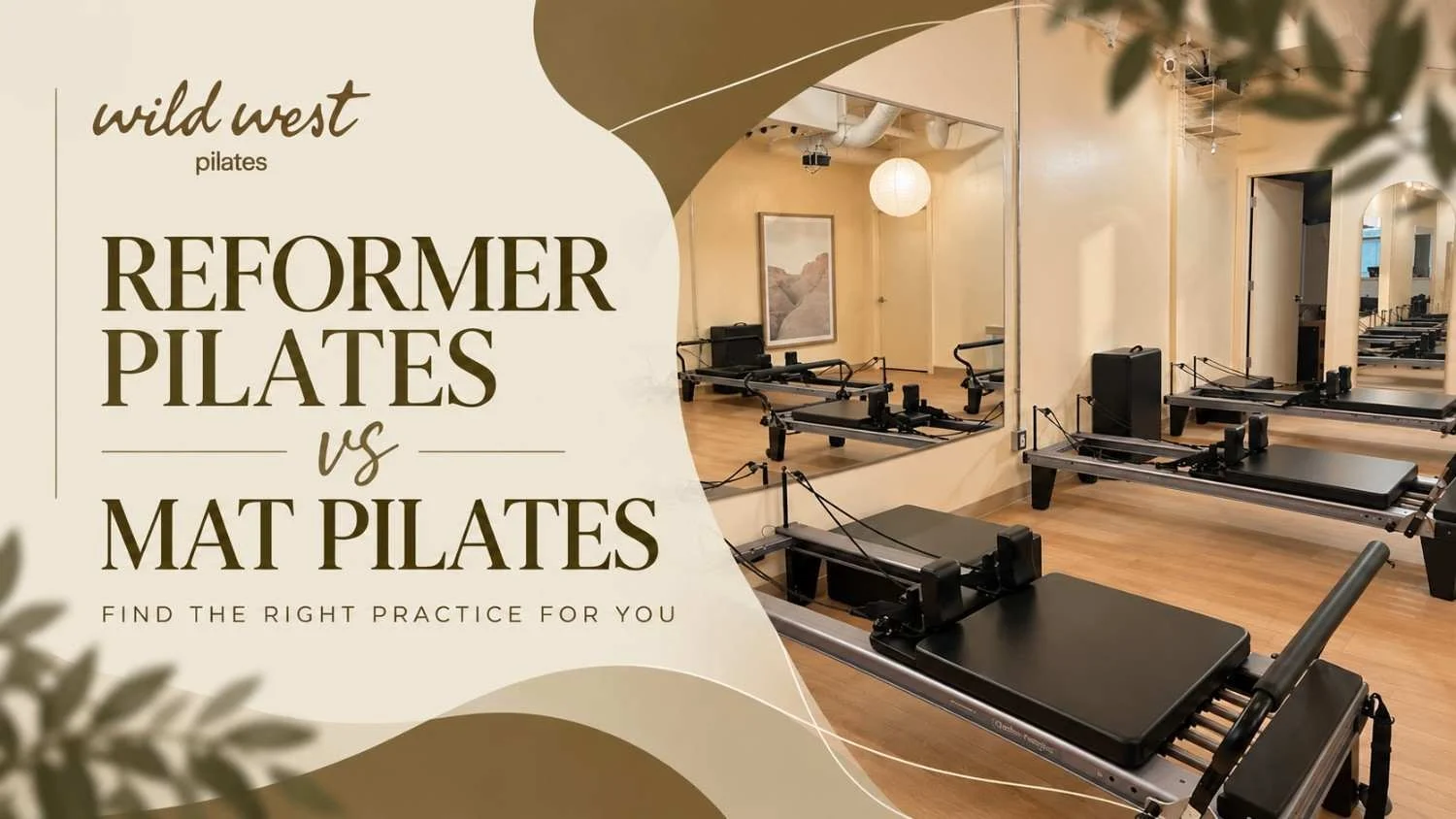
Reformer Pilates vs Mat Pilates
Thinking about trying Pilates? You’ve probably noticed two main options: Reformer Pilates and mat Pilates. Both focus on controlled movement, core strength, breathing and body awareness. The big differences are the equipment, the resistance and how the exercises feel.
So when it comes to Reformer Pilates vs mat Pilates, which one is right for you? It depends on your goals, your experience and the kind of workout you actually enjoy.
Here at Wild West Pilates in Bridgeland, Calgary, we teach small-group Reformer classes in a relaxed, welcoming studio. Whether you’re brand new or already have some Pilates under your belt, knowing the difference between the two can help you choose where to start.
What Is Mat Pilates?
If you’re wondering what is mat Pilates, it’s Pilates done on a mat, using your own body weight for resistance. Some classes add small props like resistance bands, a Pilates ring or light weights.
Mat Pilates uses slow, controlled moves to work your core, build muscle endurance and improve coordination and flexibility. You’ll lie down, sit, kneel or stand on the mat for different exercises.
Because it needs so little equipment, you can practise mat Pilates at home, at the gym or in a group class. But don’t let the simple setup fool you. Lots of mat exercises take serious strength, stability and control.
Mat Pilates might suit you if you:
Like workouts with very little equipment
Want to practise at home or while you’re travelling
Enjoy building strength with your own body weight
Want to work on core stability, coordination and flexibility
Like a workout you can fit into any space or schedule
What Is Reformer Pilates?
Reformer Pilates uses a special machine called a reformer. It has a sliding platform (called the carriage), springs that add resistance, straps for your hands or feet, and a footbar to push against. Together, they can make each exercise easier or harder.
Mat Pilates mostly relies on body weight and gravity. On the reformer, you can change the resistance just by switching springs. The carriage and straps also open up a much wider range of exercises and modifications.
A Reformer class can work your core, legs, glutes, arms, shoulders and back, all with a focus on alignment, control and breathing.
Reformer Pilates might suit you if you:
Like guided workouts on special equipment
Want resistance you can adjust
Like having an instructor show you each move and coach you through it
Want to work on strength, flexibility, balance and coordination
Enjoy working out in a dedicated studio
Our classes max out at nine people, so our instructors can actually see you and help you through every part of the workout.
Neither one is “better” for everyone. Both are great ways to do Pilates. It comes down to what fits you.
What Are the Benefits of Reformer Pilates?
A big reason people love the reformer is how adaptable it is. Springs let us make a move easier when you need support, or harder when you’re ready for more.
Here’s what many clients find:
1. Core Strength
Lots of Reformer exercises ask you to engage your abs and trunk with control. With regular practice, your core gets stronger and more stable.
2. Full-Body Strength
The reformer works your legs, glutes, arms and back in one class. (Yes, your legs might shake during footwork. That’s a good sign.)
3. Flexibility and Mobility
Controlled moves and supported stretches help you work on flexibility and move through a comfortable range of motion.
4. Balance and Coordination
Controlling the sliding carriage while staying lined up builds coordination and helps you notice how your body moves. And yes, it might slide more than you expect the first time.
5. Personalized Exercise Options
Because we can adjust the springs and your position, our instructors can modify exercises for any experience level.
Results depend on how consistently you come, your technique and your own body. Pilates is a great part of a balanced routine, but it isn’t a guaranteed fix for injuries or medical conditions. Want the full rundown? Read our post on the benefits of Reformer Pilates.
What Are the Benefits of Mat Pilates?
Mat Pilates has plenty going for it too. Because it uses mostly body weight, you can build strength and control without any special equipment.
Mat Pilates can help you:
Strengthen your core and trunk
Build muscle endurance
Practise balance, coordination and control
Work on flexibility and mobility
Get more aware of your breathing and alignment
Keep a Pilates routine going at home or on the road
Mat work can be tough, because you often have to stabilize your body without the reformer’s support. If you love simple, equipment-free workouts, mat Pilates is a great choice.
Which Is Better: Reformer Pilates or Mat Pilates?
When it comes to Reformer Pilates vs mat Pilates, the best one is the one that fits your goals, comfort level and lifestyle.
Choose Reformer Pilates if you enjoy working with equipment, want adjustable resistance or like a dedicated studio class with an instructor guiding you.
Choose mat Pilates if you want minimal equipment, more freedom about where you work out, or enjoy using your own body weight.
If you want a stronger core, more flexibility, better balance and more body awareness, both can help. Lots of people do both to get the best of each.
If you’re new to exercise or have an injury or health concern, check with your doctor or physiotherapist before you start, and let your instructor know about any limits.
Is Reformer Pilates or Mat Pilates Better for Beginners?
Both can work well for beginners when they’re taught at the right level. The main difference is the kind of support you get.
Mat Pilates teaches you the basic moves without a machine to learn. But some exercises can feel tough if you’re still building core strength or coordination.
On the reformer, the springs and carriage can support you or add challenge, depending on what you need. It takes a little time to get comfortable on the machine, so starting with an intro class and following your instructor’s cues really helps.
At Wild West Pilates, beginners start with Steady West, our slower, foundations class that helps you get comfortable with Pilates moves and the reformer. Once you’ve done a Steady West class, you’re welcome to join our Wild West Signature classes.
You don’t need to nail every move before your first class. Start where you’re comfortable, ask lots of questions and focus on good technique.
Try Reformer Pilates at Wild West Pilates in Calgary
Now that you know the difference, you can pick the style that fits your goals best.
Our Bridgeland studio keeps classes small, with nine people max, so you get a personal, friendly space to learn the moves, build confidence and progress at your own pace.
Whether you want to get stronger, more flexible, better coordinated or just try something new, our classes are a great way to explore Reformer Pilates. Come as you are, leave a little stronger.
Ready to try it for yourself? Start with 2 weeks for $79 and book your first class in Bridgeland, Calgary.
Frequently Asked Questions
1. Is Reformer Pilates harder than mat Pilates?
Not necessarily. Each is challenging in its own way. The reformer uses adjustable springs, while mat Pilates relies mostly on body weight and gravity. How hard it feels depends on the exercises, the resistance and your experience.
2. Can beginners do Reformer Pilates?
Yes. With good instruction and modifications, beginners do great on the reformer. An intro class like Steady West teaches you how the machine works and gets you comfortable with the basics.
3. Can I do mat Pilates and Reformer Pilates together?
Yes. They work really well together. Doing both adds variety and helps you build strength, mobility, coordination and body awareness.
4. Do I need equipment for mat Pilates?
Mostly just a comfortable mat. Some classes use optional props like resistance bands or a Pilates ring, but you don’t need them for every workout.
5. How do I choose between Reformer Pilates and mat Pilates?
Think about your goals, budget, access to equipment and the kind of class you enjoy. If you like instructor-led workouts with adjustable resistance, try the reformer. If you prefer a simple routine with minimal equipment, mat Pilates may suit you better.
